
Donor-Advised Funds: How They Work, Tax Basics and Altruist

William Cole · · 14 min read
Series 65 · CRD #7004357
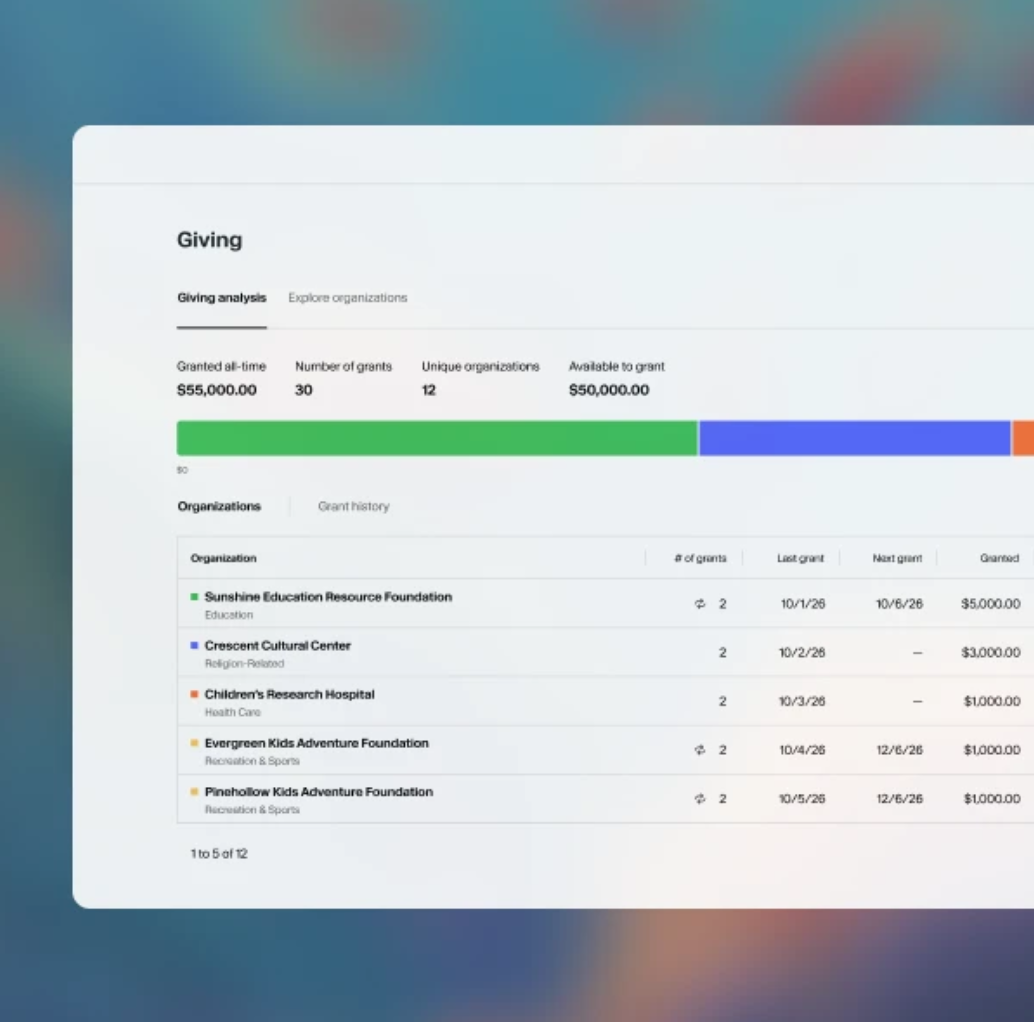
Illustrative example of a giving dashboard in Altruist. Amounts, organizations and dates shown are sample data for illustration only and do not represent actual client accounts, transactions or offerings.
What is a donor-advised fund?
A donor-advised fund (DAF) is a charitable account held at a public charity called a sponsor. You contribute cash or securities, may be eligible for a deduction if you itemize, and later recommend grants. The sponsor owns the assets, approves each grant and keeps a record of your contributions and grants, but the gift cannot be taken back.
A DAF also centralizes the paperwork of giving. Many donors do not keep consistent records of cash gifts, and giving shares directly to several charities generally means a separate transfer, acknowledgment and record for each one. In a DAF, contributions and grants are tracked in one account, and the sponsor issues the contribution acknowledgment you need for your return. That built-in tracking and reporting is a large part of the appeal, and it is a convenience you pay for through fees. A tax professional can confirm what documentation your return needs.
This article is general education, not tax, legal or investment advice. Tax rules change and individual circumstances matter. Rule descriptions are as of October 14, 2026 and cite IRS material. Altruist is the custodian LKL Advisors uses for client accounts. Descriptions of Altruist's donor-advised fund features come from Altruist's public website as of October 14, 2026. They are not a recommendation of any sponsor or product, and features, fees and sponsors may change.
Talk through whether a donor-advised fund fits your situation
How does a donor-advised fund work?
The IRS describes a donor-advised fund as a separately identified fund or account maintained and operated by a section 501(c)(3) organization, called a sponsoring organization. Once you contribute, the organization has legal control over the assets, while you keep advisory privileges over how the money is distributed and invested (IRS, Donor-advised funds, as of October 14, 2026).
In practice, most DAFs follow the same four steps:
- Open the account. You set up a DAF with a sponsor, either directly or through a platform that offers one.
- Fund it. You contribute cash or other assets the sponsor accepts, such as publicly traded securities. Sponsors set their own rules for what they accept, and some may decline complex assets.
- Invest it. Assets in the account are invested within the sponsor's investment policy until they are granted.
- Recommend grants. Over time, you recommend grants to eligible charities. The sponsor reviews each recommendation, approves it, and sends the grant. The account keeps a history of contributions and grants, so you do not have to assemble that record yourself.
Because the sponsor legally owns the assets, recommendations are advisory only. That is the central trade-off: flexibility on timing and recipients, in exchange for giving up control and the ability to reverse the gift.
Why might someone use a donor-advised fund?
A DAF is one of several ways to give. Much of what it offers is convenience, and convenience has a price in platform and sponsor fees. These are the reasons people commonly consider one, each paired with its limit:
- To keep giving records in one place. Many donors do not keep consistent records of their cash gifts, especially smaller ones, and gathering receipts at tax time can be time-consuming. A DAF keeps a built-in record of contributions and grants. The trade-off is that you still need to keep the sponsor's acknowledgment, and the record exists only for giving that runs through the account.
- To separate the timing of the deduction from the timing of the gifts. A contribution to the sponsor may be deductible in the year it is made, while grants to charities can follow over months or years. The trade-off is that the contribution is irrevocable, and the deduction helps only if you itemize.
- To give appreciated securities with less paperwork. Contributing long-held securities instead of selling them may avoid realizing the gain a sale would create. Giving shares directly to several charities generally means a separate transfer, a separate acknowledgment and separate records for each one. A DAF turns that into one gift of securities to the sponsor, with grants to charities made later in cash by the sponsor. The trade-off is that a gift of securities to the DAF still carries its own tax reporting, a lower percentage-of-income limit for appreciated property, and the need to coordinate with your plan, trading windows and holding periods if the shares came from equity compensation. See our guide to charitable giving and donating shares and our overview of equity compensation planning.
- To avoid running a private foundation. A DAF sits inside a sponsor that already handles administration and IRS reporting. The trade-off is less control than a foundation would give you, and the sponsor has the final say on grants.
- To involve the next generation. Many sponsors let a donor name successors who may recommend grants later. Sponsor policies vary, and this is a legacy topic to coordinate with an estate attorney. See estate planning: advisor vs. attorney roles.
How does the tax deduction for a donor-advised fund work?
Tax treatment depends on your return, so the points below are general. Confirm how they apply to you with a tax professional.
- You generally need to itemize. According to IRS Publication 526 (2025), to deduct a charitable contribution you generally must itemize deductions on Schedule A. The deduction is taken for the contribution to the sponsor. Later grants to charities are not separately deductible.
- Percentage limits apply. Publication 526 (2025) describes a limit of 60% of adjusted gross income (AGI) on cash contributions to 50%-limit organizations, which include public charities, and a general limit of 30% of AGI on noncash contributions of capital gain property to those organizations. An election to use the 50% limit for capital gain property reduces the deduction by the amount that would have been long-term capital gain. Contributions above the limits may generally be carried forward to later years.
- Appreciated property is usually valued at fair market value. Publication 526 says that for capital gain property you can generally use the fair market value, with exceptions. Valuation, holding-period and appraisal rules can apply to some assets.
- The sponsor must acknowledge the gift. Publication 526 says you can't deduct a DAF contribution without a contemporaneous written acknowledgment from the sponsor that it has exclusive legal control over the assets. Separate acknowledgment rules apply to contributions of $250 or more (IRS Topic no. 506).
- The 2026 non-itemizer deduction generally does not cover DAF gifts. Beginning with tax year 2026, taxpayers who do not itemize may deduct up to $1,000 ($2,000 if filing jointly) of cash contributions to certain qualified organizations (IRS Topic no. 506). IRS Publication 6196 (10-2026) states that donations made to donor-advised funds generally do not qualify for this deduction.
- Recordkeeping is your responsibility, and a DAF may reduce the work. The IRS says a cash gift of any amount needs a bank record or a written communication from the charity, and a gift of $250 or more needs a contemporaneous written acknowledgment (IRS Topic no. 506). A noncash gift over $500 requires Form 8283, and an item over $5,000 requires a qualified appraisal. If you give directly to many charities, that is a record for each gift and each organization. With a DAF, your contribution to the sponsor is one gift with one acknowledgment, and the sponsor handles the later grants. A gift of securities to the DAF still carries these noncash reporting rules.
- Timing matters. Contributions generally must be completed before the close of the tax year to be deductible that year (IRS, Charitable contribution deductions). Moving securities between institutions can take time, so year-end gifts may need an earlier start.
- Rules may continue to change. The Publication 526 edition cited here is for 2025 returns. Confirm the limits that apply to your 2026 return with a tax professional before relying on them.
The IRS also cautions that some arrangements promoted as donor-advised funds may be set up to generate questionable deductions. Confirming that a sponsor is a recognized public charity is part of the basic homework (IRS, Donor-advised funds).
How do donor-advised funds work on Altruist?
Altruist, the custodian LKL Advisors uses, offers donor-advised fund accounts for advisors and their clients. The platform is designed to keep the DAF alongside a household's other accounts, which may reduce the number of separate logins, statements and processes a client has to manage. In many ways, what a DAF on Altruist provides is convenience: the contribution record, grant history and tax acknowledgments are kept in one place, for a fee. The details below come from Altruist's donor-advised funds page as of October 14, 2026.
- Sponsor. DAFs on Altruist are sponsored by Endaoment, a 501(c)(3) public charity that legally owns the assets, handles IRS obligations, and approves grants. Contributions are irrevocable, and grant and investment recommendations are advisory only.
- Opening. The advisor selects the donor-advised fund option at account opening and sends it to the client to accept, after the advisory firm completes a one-time onboarding step.
- Funding. An account can be funded with cash, with securities moved in without selling them, or by transferring a DAF held at another sponsor. A transfer works like a grant from the current sponsor, and how fast it completes is up to that sponsor.
- Investing. Advisors choose investments within the sponsor's investment policy, which sets what is eligible. Options include models, custom portfolios and personalized indexing strategies.
- Granting. Clients can search eligible charities, save favorites and recommend grants from the web portal or app, with no grant minimum. Grants can also be made anonymously. The sponsor approves each recommendation.
- Tracking and reporting. DAF balances, holdings, contributions, grants, available cash and giving history appear automatically in the household view alongside every other account, and the same data flows through existing integrations to third-party reporting tools. The sponsor issues the contribution receipt and annual acknowledgment, delivered through Altruist's document center, so the documents you need at tax time are stored with the account. Grants are not separately deductible, because the deduction applies at contribution. This kind of built-in record may help donors who would otherwise track gifts across several charities, receipts and brokerage transfers by hand. A tax professional can confirm what documentation your return needs.
- Minimums. There are no opening, balance or grant minimums.
- Fees. The DAF is charged a tiered platform fee, billed monthly, that starts at 0.50% a year on the first $500,000 and steps down as the balance grows. According to Altruist, this fee is separate from advisory fees, Altruist's custody fees and fund expenses, and other fees may apply. See Altruist's fee schedule and DAF disclosures for current terms.
What are the trade-offs of a donor-advised fund?
| Consideration | Possible benefit | Possible limit |
|---|---|---|
| Irrevocable gift | Money is set aside for charity now, with recipients chosen later | You cannot take the money back or redirect it to anything other than charity |
| Tracking and paperwork | Built-in record of contributions and grants, and one acknowledgment from the sponsor instead of one per charity | You are paying for convenience, and you still need to keep the sponsor's acknowledgment and any noncash reporting |
| Tax deduction | May be deductible in the year of contribution if you itemize | No deduction if you take the standard deduction, and percentage limits apply |
| Appreciated securities | May avoid realizing a gain that a sale would create, without transferring shares to each charity separately | Holding-period, valuation and reporting requirements still apply to the gift, and limits are lower than for cash |
| Control | Flexible timing and recipients for grants | The sponsor has legal ownership and final approval |
| Investing | Assets may be invested while they wait to be granted | Investments are limited to the sponsor's policy and can lose value, reducing what is available to grant |
| Fees | Administration, receipts and reporting are handled by the sponsor and platform | Platform, sponsor and fund fees are the price of that convenience and may reduce what is available to grant |
| Legacy | Successors may be named | Sponsor policies vary, and legal questions belong with an attorney |
Is a donor-advised fund a fit? Questions to ask
These questions may help you and your tax professional decide whether a DAF fits:
- Do you itemize, or would you expect to in the year you give? Without itemizing, a DAF contribution may not produce a deduction.
- Are you giving enough, and often enough, for the added structure to be worthwhile?
- Would you give cash, or appreciated securities held longer than a year? The tax treatment and limits differ.
- Is this a year with unusually high income, such as an equity vesting or a sale? The timing of a deduction may matter more in those years.
- Are you comfortable that the gift is irrevocable and the sponsor has final say?
- How much is the convenience worth to you, and what is the total cost? Consider how much value you place on consolidated records and fewer per-charity transfers, and compare platform, sponsor, investment and advisory costs.
- Do you want successors to continue the giving? If so, coordinate with an estate attorney.
If most answers are "no" or "unsure," giving directly to charities may be simpler and may cost less, as long as you keep your own records. If several are "yes," a DAF may warrant a closer look with a tax professional.
What to bring to a planning conversation
- Your most recent tax return, including Schedule A if you itemized
- Your expected income and deductions for this year and next
- A list of charities you support and your typical giving, with receipts or bank records for this year's gifts
- Holdings you might give, with cost basis and purchase dates
- Equity compensation details, such as vesting dates and trading windows
- Any DAF you already hold, including the sponsor and current balance
- Estate planning documents or notes on how you would like giving to continue
- Your questions about state taxes
How this fits into planning at LKL Advisors
Charitable giving is one input into broader planning, alongside cash flow, taxes and goals. Our articles on direct indexing and tax-loss harvesting and the financial order of operations cover how low-basis holdings, realized gains and competing priorities may interact with giving decisions. You can see the full list of services. Results vary by individual circumstances and may involve trade-offs, and we coordinate with your tax professional and, for legal documents, your attorney rather than replace them.
Our published fee structure covers planning under one fee, with no account minimums. To ask a question, you can contact us here.
Talk through whether a donor-advised fund fits your situation
Frequently asked questions
What is a donor-advised fund?
It is a charitable account held at a public charity, called a sponsor. You contribute assets, may be eligible for a deduction if you itemize, and later recommend grants to charities. The sponsor legally owns the assets and approves each grant.
Why use a donor-advised fund instead of giving directly?
Much of the appeal is convenience. A DAF keeps contributions, grants and acknowledgments in one place, and giving appreciated shares means one transfer to the sponsor instead of a separate transfer and acknowledgment for each charity. That convenience is paid for through fees, and the gift is irrevocable. Giving directly may cost less if you are comfortable keeping your own records.
Is a donor-advised fund contribution tax deductible?
It may be, if you itemize deductions and meet the IRS requirements, including a written acknowledgment from the sponsor. Percentage-of-income limits apply. IRS Publication 6196 (10-2026) states that gifts to donor-advised funds generally do not qualify for the new 2026 non-itemizer deduction. A tax professional can review your situation.
What are the downsides of a donor-advised fund?
The gift is irrevocable, the sponsor has final say on grants, and the deduction helps only if you itemize. Fees, which are the price of the built-in tracking and reporting, may reduce the amount available to grant, and investments can lose value. Complex assets can take longer to accept and may be declined.
Can I give appreciated stock to a donor-advised fund?
Many sponsors accept publicly traded securities. Giving long-held securities instead of selling them may avoid realizing the gain, though holding-period, valuation and percentage limits apply. If the shares came from equity compensation, plan rules and trading windows may also matter.
How do donor-advised funds work on Altruist?
According to Altruist's website as of October 14, 2026, the advisor opens the account, it can be funded with cash, securities or a transfer from another sponsor, and the client can recommend grants from the Altruist portal or app. The sponsor, Endaoment, approves each grant. Fees and terms may change.
Can I move an existing donor-advised fund to Altruist?
Altruist states that a transfer works like a grant: a new DAF is opened on Altruist, and the current sponsor is asked to grant the balance to it. How quickly it completes depends on the current sponsor. Ask your current sponsor about any restrictions or timing.
Does LKL Advisors give tax or legal advice?
Our planning includes tax awareness, and we coordinate with your tax professional. We do not draft legal documents or provide legal advice. Questions about how these rules apply to your return belong with a licensed tax professional, and legal questions belong with an attorney.
Sources
- IRS, Donor-advised funds, accessed October 14, 2026
- IRS, Publication 526 (2025), Charitable Contributions, accessed October 14, 2026
- IRS, Topic no. 506, Charitable contributions, accessed October 14, 2026
- IRS, Publication 6196 (10-2026), Charitable Contribution Deduction Tips for Non-Itemizers, accessed October 14, 2026
- IRS, Charitable contribution deductions, accessed October 14, 2026
- Altruist, Donor-advised funds, accessed October 14, 2026. Altruist's page states that platform screens shown are examples and do not represent actual transactions or offerings.
LKL Advisors is based in Atlanta, Georgia, and works with clients across the country, wherever we are registered or otherwise permitted to serve them. Planning is done remotely through secure virtual platforms, so you do not need to be in Atlanta to work with us.
This article is for informational purposes only and should not be construed as investment, tax, or legal advice. Please consult a licensed professional before making financial decisions. Advisory services are offered through LKL Advisors, LLC, a Georgia-registered investment adviser. Investing comes with risk of loss, and past performance is not indicative of future performance.
Related articles
- Tax Strategy
Direct Indexing and Tax-Loss Harvesting: How They Work Together and What the Trade-Offs Are
How direct indexing may create tax-loss harvesting opportunities, who it may suit, and the trade-offs to weigh: wash-sale rules, lower basis, tracking difference, and fees. Educational only.
October 13, 2026 · 9 min read - Equity Compensation+1
Equity Compensation Planning: How Stock Options, RSUs and ESPPs Fit Into a Financial Plan
A general guide to equity compensation planning for startup and tech employees: how stock options, RSUs, and ESPPs differ, and how equity may fit into cash flow, taxes, and risk.
October 13, 2026 · 11 min read - Financial Planning
Estate Planning: Advisor vs. Attorney Roles
What a financial advisor does in estate planning, what an estate attorney does, and how the two coordinate on beneficiaries, account titling, trusts, taxes, and insurance.
October 9, 2026 · 7 min read